

Hospitality AI can only work with the data the industry makes visible.
Hospitality is racing towards artificial intelligence. From revenue management and forecasting to marketing, sales and operational efficiency, AI is being positioned as a technology that will reshape how hotels operate.
It probably will. But amid the excitement, the industry must confront an uncomfortable question: what happens when the data AI needs simply is not there?
AI does not magically create market intelligence. It identifies patterns, relationships, and opportunities from information. If that information is incomplete, inconsistent, fragmented or poorly defined, the resulting insights will be limited. Before hospitality can fully capitalise on AI, it needs the data foundation. A significant gap sits within an important part of hotel business: Meetings & Events.
We know an extraordinary amount about hotel rooms
Hotel rooms benchmarking is sophisticated. Operators routinely monitor occupancy, Average Daily Rate, Revenue per Available Room, booking pace, segmentation, historical trends and competitive-set performance. These standardised measures show hotels not only how they are performing, but how that performance compares with the market.
Context matters. A hotel increasing room revenue by 5 per cent might appear successful. If its competitive market has grown by 10 per cent, however, the story changes. Yet when we move from bedrooms into meeting rooms, ballrooms, conference spaces and function areas, market visibility becomes considerably less clear.
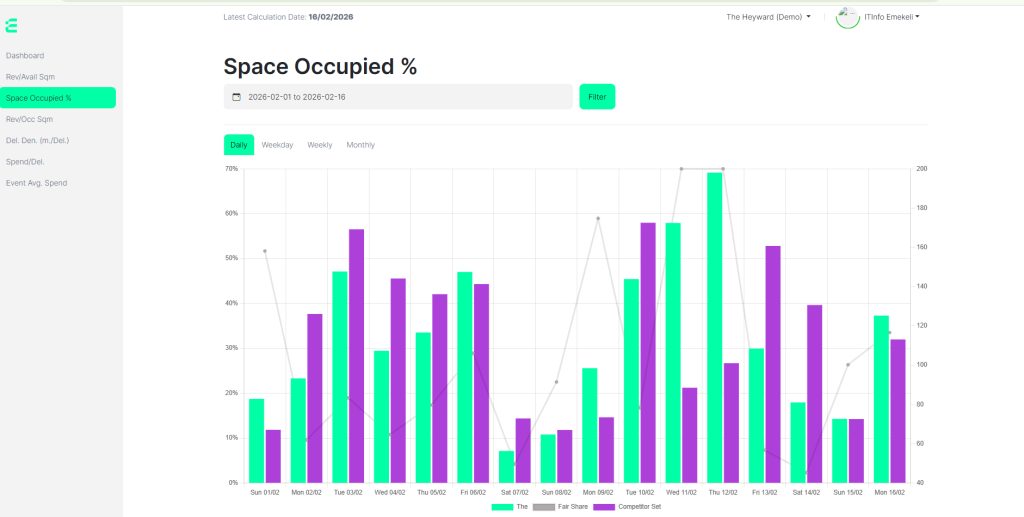
Meetings & Events has data, so what is missing?
Hotels generate Meetings & Events data. Sales and catering systems may hold enquiries, confirmed events, lost business, lead times, delegate numbers, space utilisation, food and beverage revenue, room hire, event types and conversion.
The problem is not the absence of data. Much of it remains inside individual hotels, groups, technology platforms and separate systems. Definitions vary, systems record information differently and measures are not always standardised. Comparing one hotel’s performance with another, or with the wider market, can therefore be difficult.
A Director of Sales might know that a ballroom generated $500,000 last quarter. But was that result strong? Could it have generated $600,000? Was market demand rising or falling? Did competitors capture business the hotel missed? Was the space used efficiently? Without consistent market benchmarks, these questions are much harder to answer.
Australia illustrates the challenge
Australia has valuable business-events research, including work through Tourism Research Australia and industry organisations. It provides insight into visitor activity and expenditure, while also recognising limitations in measuring the sector’s full economic contribution.
This does not mean Australia’s business-events data is poor. It highlights the difference between industry-level economic research and property-level hotel benchmarking. A hotel deciding how to price a ballroom, whether to accept one event over another, or whether its meeting space is outperforming its competitive market needs a different level of information.
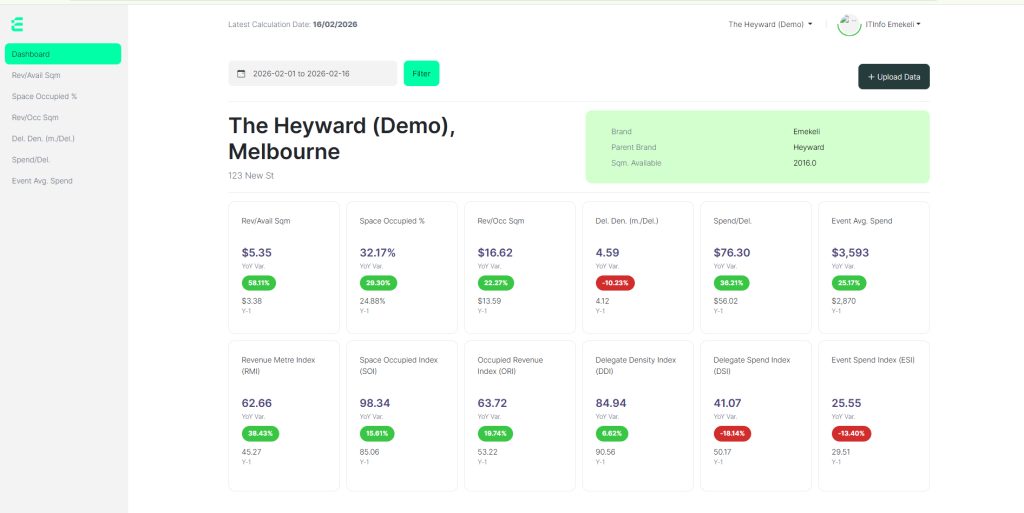
Globally, we have pieces of the puzzle
Internationally, sophisticated providers deliver intelligence on RFP activity, requested room nights, event volumes, booking behaviour, conversion, lead times, cancellations, account activity, profitability and event performance. Meetings & Events demand data exists.
The challenge is that providers and hotel systems often measure different parts of the ecosystem. One platform may understand RFP activity; another, actualised events. Another may hold a hotel’s function-space revenue, while another provides destination-level statistics. Each dataset is valuable, but together they do not necessarily give hotels a standardised, comparable view of demand and performance across their competitive market.
Why this matters for AI
Imagine asking: What is likely to happen to corporate meeting demand in my market over the next 90 days? Which enquiries should my sales team prioritise? Are we pricing our ballroom correctly? Which spaces are underutilised, and where are our greatest revenue opportunities?
AI could eventually help hotels answer these questions, but the sequence matters. First comes data. Then benchmarking. Then intelligence. Only then can AI deliver sophisticated forecasting, decision support and optimisation.
The principle extends beyond hospitality. The US National Institute of Standards and Technology’s AI Risk Management Framework highlights data quality, representativeness, validity and reliability. Put simply, AI capability and data capability cannot be separated.
Building the foundation
The industry’s biggest opportunity may not be collecting more data. Hotels already produce vast quantities. The opportunity is to establish consistent definitions and standardised measures so information can be securely aggregated, anonymised, compared and transformed into useful market intelligence.
That is the challenge Emekeli Research is working to address. Our focus is standardising Meetings & Events performance metrics and securely aggregating anonymised operational data, helping hotels understand market demand, competitive performance, space utilisation, revenue performance and trends.
The objective is not to replace the valuable systems and datasets already operating across the ecosystem. It is to close the gap between rich operational data inside hotels and the market context needed for better commercial decisions.
The hospitality industry is understandably asking, “What can AI do for us?” Perhaps it should ask another question first: “Do we have the data AI needs to do it?”
AI can analyse, forecast, recommend and optimise. But AI cannot see what the data does not show. If hotels could see Meetings & Events demand as clearly as room demand, what would they price, sell, forecast or invest in differently?
Yona Heyward is Director and Co-Founder of Emekeli Research, a benchmarking and market intelligence platform for hotel Meetings & Events.
www.EmekeliResearch.com